A new hiring trend has been shaping up in the last couple of years.
Skill-based hiring is a hiring approach where candidates are evaluated based on skills and capabilities they can show. Instead of relying on educational background, college degree, or years of experience as the main screening criteria, employers assess the technical and soft skills that the role requires. The focus is on what the person can do, not just on what’s on their resume.
For example, when hiring for an entry-level software developer role, an employer may place greater value on a candidate’s coding ability, GitHub projects, or performance on a technical assessment than on the specific university they attended, their GPA, or whether they have a computer science degree.
For career centers and candidates themselves, this is a massive shift.
This guide breaks down how you can best support your students and help them adapt. If you work for a workforce development organization or are preparing early-career candidates for employment, you’ll find these tips useful too.
Employers Changed the Hiring Format Faster than Anyone Noticed
For many years, hiring decisions often relied on university degrees and previous employers as the main signs of a candidate’s ability.
Today, skills-based hiring is changing the way companies evaluate talent. The main difference: a candidate’s proven skills and ability to learn matter more than academic qualifications or years of experience. This approach creates opportunities for a wider range of job seekers to compete based on their abilities rather than their credentials.
Here’s what skills-based hiring may look in practice:
A senior walks into a final-round interview having done everything her career center recommended. She has researched the company, mapped her experience to the job description, and rehearsed three solid STAR stories she can adapt on the spot.
Ten minutes in, the interviewer sets the resume aside and says something she wasn’t expecting: “Instead of telling us about a time you solved a problem, we’d like to watch you solve one. Here’s a scenario our team ran into last quarter. Take a few minutes, then walk us through your thinking.”
The candidate has the skills. She’s probably solved harder problems in a group project or a part-time job. What she doesn’t have is any practice performing that thinking out loud, in real time, while someone scores her against a rubric she has never seen.
This is where more and more otherwise well-prepared candidates lose the offer, and it points to a career readiness gap that most career centers haven’t structured their programming around yet.
The State of Skills-Based Hiring Today
Skills-based hiring stopped being an experiment several years ago, and the data now shows it settling in as the default for early-career roles.
In NACE’s Job Outlook 2026 survey, 70% of employers reported using skills-based hiring, up from 65% the year before, and 71% of those employers said they use the approach at least half of the time.
The stages where it shows up most are the ones candidates feel directly. Employers apply skills-based practices most often during interviewing (87%) and screening (65%), and they build those practices into the key elements of the hiring process, including job descriptions (81%) and interview rubrics (58%).
Another change happened simultaneously. In 2019, roughly 70% of employers screened candidates by GPA. That figure is now 42%. The transcript alone is no longer enough to prove a candidate’s potential. Instead, employers want evidence that students can apply their skills in real-world situations.
A good example is AI, even for experienced candidates. According to TestGorilla’s State of Skills-Based 2025 research, 53% of hiring managers now prefer a candidate with AI fluency over one with deeper domain expertise. This shows that having the right skills can be more valuable than simply having a strong employment history.
Students, meanwhile, are living inside the old system. NACE’s 2025 Student Survey found that fewer than 40% of graduating seniors were familiar with the term “skills-based hiring,” even though nearly 46% had already been asked to show their skills through an assessment during an interview, and nearly 9 out of 10 had taken part in a program or activity designed to build career-relevant skills.
Why Companies Are Switching to Skills-Based Hiring
The reasons are mostly practical. Structured evidence produces more consistent decisions than gut feel, and a rubric applied to every candidate is easier to defend than a hiring manager’s impression.
Broader industry research points in the same direction: TestGorilla found that 85% of surveyed employers use some form of skills-based hiring and 76% use skills tests to validate what candidates claim, while more than 50% have removed degree requirements from at least some postings.
For higher education, the consequence is clear: when employers stop using the degree as a shortcut for capability, the burden of proof moves onto the student, and it lands hardest in the interview.
What Is a Skill-Based Interview and How to Prepare for It
A skill-based interview is an interview format that focuses on whether a candidate has the specific skills, abilities, and behaviors needed to perform a job, rather than mainly evaluating their degree, job titles, or years of experience.
In a skill-based interview, a candidate may be asked to demonstrate evidence of their capabilities through examples, scenarios, tasks, or practical exercises.
NACE’s Job Outlook 2026 Spring Update found that when employers review resumes for entry-level positions, they look hardest for evidence of teamwork, problem-solving, and communication, and those same competencies carry into the interview.
Typical questions include:
- Tell me about a time you had to work with someone whose approach was very different from yours.
- Describe a situation where you had to make a decision without all the information you wanted.
- How would you explain something complicated to someone outside your field?
- Walk me through a project that didn’t go the way you planned, and what you did about it.
- Tell me about a time you had to reprioritize when your workload changed suddenly.
The newer variants are the ones that catch students off guard, because they ask for demonstration rather than only telling a story.
- Here’s a data set. Take fifteen minutes and tell us what you’d recommend.
- Draft a short response to this customer complaint and explain your reasoning.
- We’ll give you a scenario and a whiteboard. Show us how you’d approach it.
Most students will encounter these skill-based questions for the first time in an interview with a hiring manager. At this stage, the goal is usually to understand how a candidate has used their skills in real situations. Behavioral questions, often answered using the STAR method (Situation, Task, Action, Result), help employers assess skills like communication, teamwork, problem-solving, and adaptability.
Later stages of the process may move from “Tell me about a time…” to “Show me how you would do it.” In a technical interview, employers may ask candidates to analyze information, complete a task, solve a problem, or explain their approach. These exercises give employers a closer look at how candidates apply their skills in practice.
How Students Can Fill The New Career Readiness Gap
The instinct in higher education is to respond to this shift by teaching more skills. That instinct is understandable but mostly misplaced, because the evidence shows students are already developing the competencies employers want.
What they can’t do is recognize those competencies in their own experience, name them in the language a hiring rubric uses, and produce evidence on demand.
Here are 4 areas where you can help students adapt to the new reality:
Recognize the skills they’ve already built
Most students underestimate coursework, lab sections, campus organizations, part-time retail and food service jobs, athletics, and caregiving responsibilities. These all generate real evidence of problem-solving, conflict resolution, and working under pressure. Students discount this experience because it doesn’t look like a job, which means someone has to help them see it differently.
Connect those skills to a specific role
A generic inventory of strengths isn’t useful in a skills-based interview. Students need practice reading a job description, analyzing it for core competencies, then selecting which of their experiences speak to each one. Reading a posting for skill signals is a teachable habit, and it’s the step where counselors can help the most.
Support the claim with a concrete example
Employers responding to NACE’s Job Outlook survey said the single most effective thing students can do to demonstrate skills is share specific examples and situations where they used those skills to solve problems. Structures like the STAR method exist for exactly this reason, though the structure only helps if students have selected genuinely relevant material to put inside it.
Show the skill when asked
This is the capability most programs miss. Explaining a competency and performing one are different tasks, and a student who has only ever done the first will struggle badly the first time an employer asks for the second.
Students with Limited Experience Need Most Practice
Skills-based formats feel most threatening to students who have the least conventional experience, which is the opposite of the intent. The approach is supposed to widen access by valuing capability over pedigree, and it does, but only for candidates who know how to show it.
First-generation students, career changers, and students who worked through school rather than interning are frequently sitting on strong material they’re likely to dismiss.
A student who spent two years as a shift lead at a coffee shop has handled understaffing, escalating customer conflict, cash accountability, and training new hires. Those experiences answer competency questions about leadership, communication, and working under pressure at least as well as an internship does, if the student has practiced telling them in the way the hiring team expects.
Confidence is the other half of it. Anxiety in competency-based interviews mostly comes from unfamiliarity, and that’s fixable through exposure. Students who have worked through a timed scenario a few times, watched themselves do it, and adjusted are noticeably steadier than students encountering the format for the first time in a real interview.
What Your Career Center Should Do Next
The programming implication is clear, but not easy to resource. Students need repeated opportunities to explain and demonstrate their competencies in the formats employers actually use, with specific 1–1 feedback.
A single mock interview per student won’t produce that. What builds confidence is volume and variety: multiple attempts, mixed question types, timed exercises, recorded responses students can watch back, and rubrics that mirror what employers actually score.
Several practical moves make this doable without proportional staff time:
- Use employer-style rubrics openly — Show students the criteria before they practice, so they understand that structured interviews reward specificity by design.
- Build competency vocabulary into advising — Practice naming the skill a student just described, in the language a job description would use.
- Make recorded practice routine — Students catch filler words, hedging, and rambling in their own recordings far faster than they absorb the same feedback secondhand.
- Extend practice beyond appointment hours — Career centers can’t provide unlimited 1–1 support for every student. Tools that students can use as homework help them continue practicing independently between appointments.
Big Interview can help students prepare for the conversation-based part of the interview process.
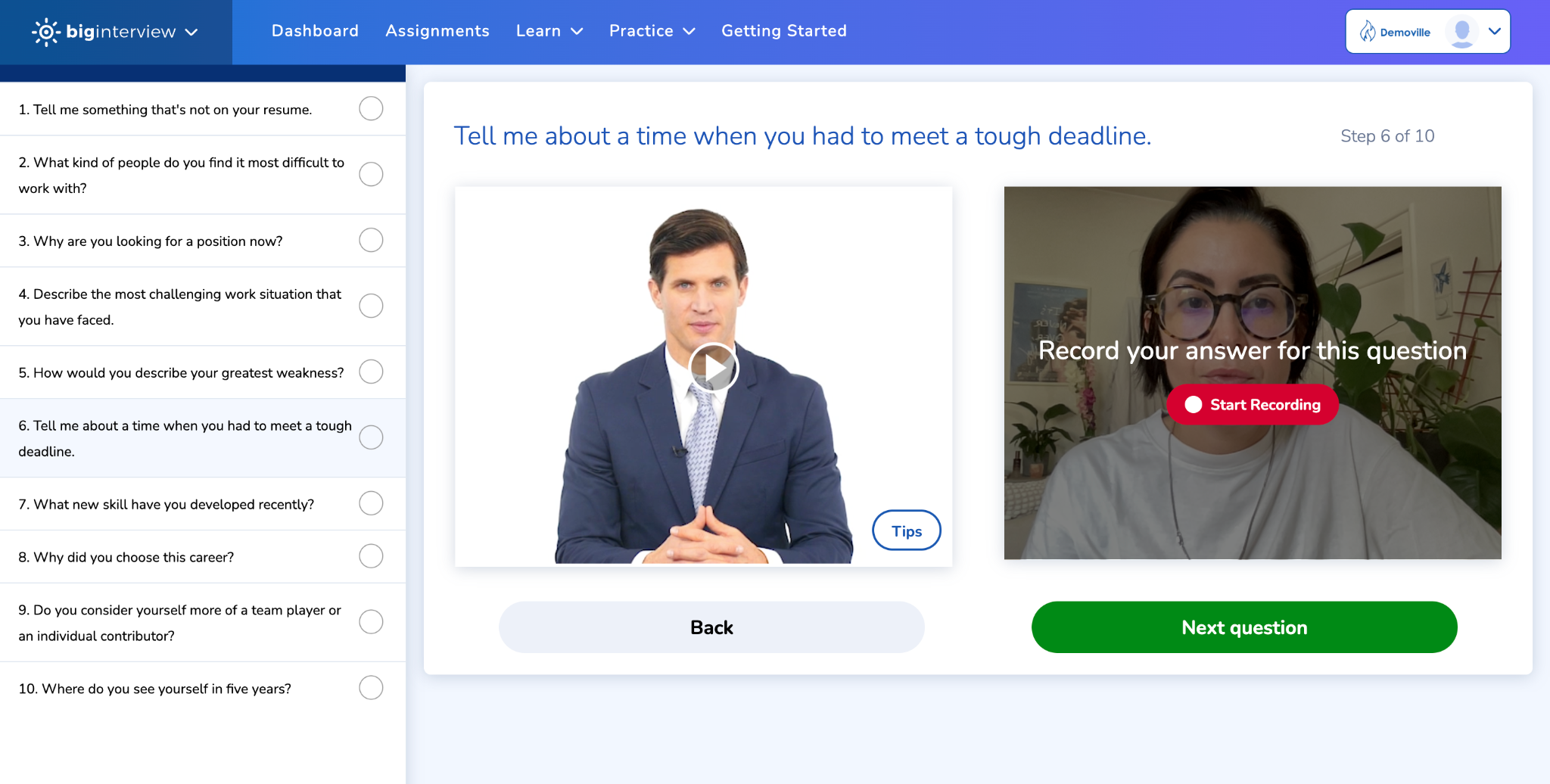
The Interview Simulator tool and PracticeAI let students run through skill-based questions as many times as they need, record and review their answers, and receive structured feedback on the elements a live interviewer would notice, including pacing, filler words, and whether the answer actually landed on the question.
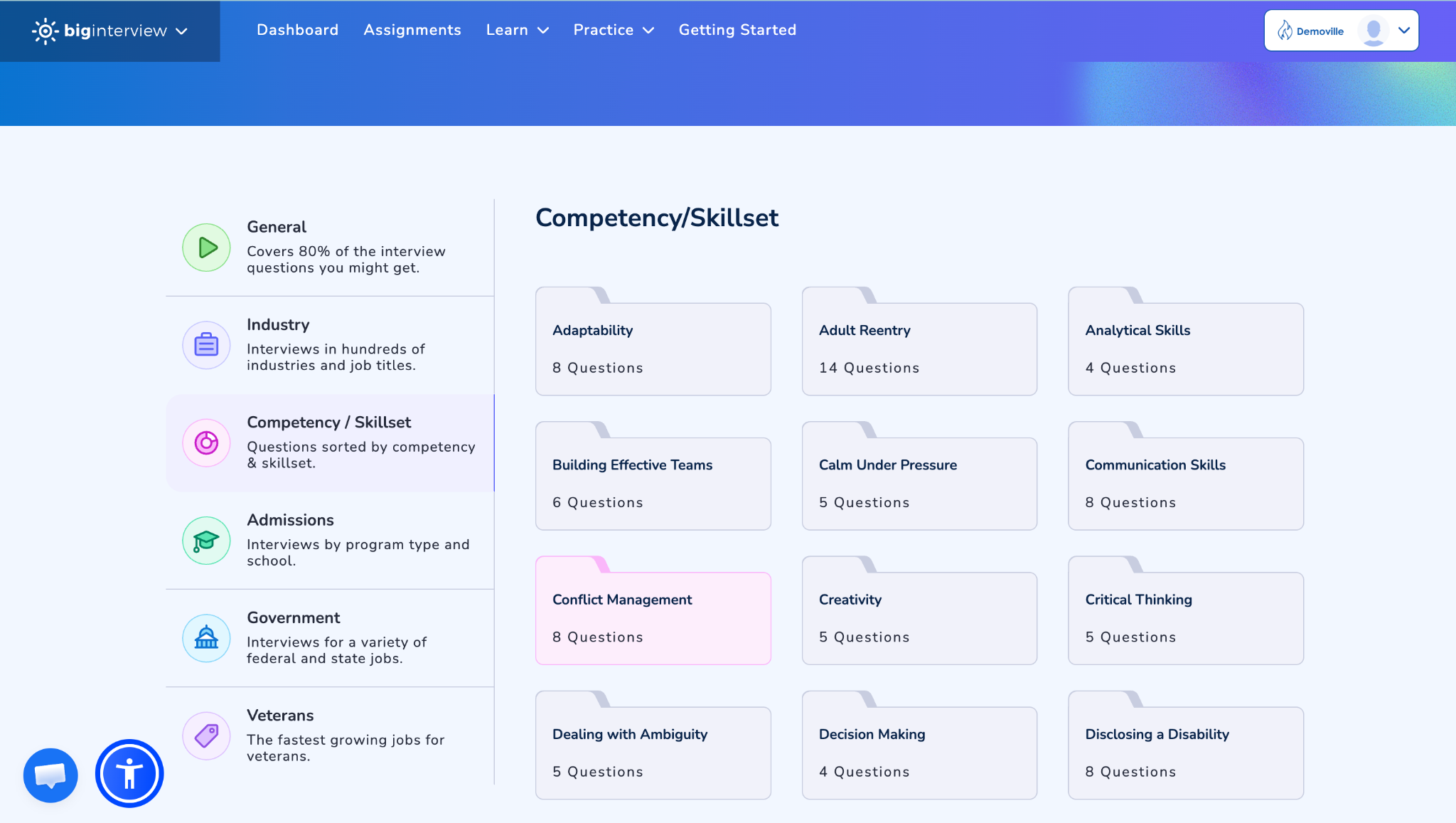
The Question Library gives them curated question sets by competency and role, so a student can drill teamwork or problem-solving specifically rather than practicing at random.
For students, this means they will be able to clearly explain their skills, experiences, and problem-solving approach, which can often determine if they move forward to later interview stages, including technical interviews or work sample assessments.
For career center teams, the value is capacity: students can accumulate meaningful practice hours between appointments, and staff time goes toward the coaching that only a human can provide.
If your career center is still not using Big Interview to scale interview prep, book a strategic call to learn more about the platform or see how you can help more students without adding head count.
FAQ
How is a competency-based interview different from a behavioral interview?
They overlap almost entirely. Competency-based interviews are essentially behavioral interviews organized around a formally defined competency framework, so the questions look familiar while the scoring is more systematic. The practical advice for students is the same in both cases: prepare specific, structured examples for each core skill in the job ad. Competency-based interviews may include a “task” that the candidate needs to solve in the interview.
Should students use a skill-based resume?
No. Recruiters distrust it and applicant tracking systems parse it poorly. A stronger approach keeps the chronological structure while loading bullets with skill evidence and outcomes. A targeted skills section after the experience section should mirror the language from the job ad.
How can students without internships prepare for skills-based interviews?
By mining the experience they already have. Group projects, part-time work, campus leadership, volunteering — all produce good and usable evidence of teamwork, problem-solving, and working under pressure. Candidates should learn how to identify which experiences map to which competencies, then practice those stories until they can explain them clearly and briefly under pressure.
Does a college degree still matter in the world of skill-based hiring?
Yes. A degree is valuable because it shows subject knowledge, commitment, and the ability to complete a structured program of study. For many professions like medicine, law, engineering, or accounting, a degree is still a mandatory qualification.
What can career centers do with limited staff capacity?
Prioritize repetition over polish. A student who has practiced ten competency questions across several sessions and reviewed recordings of their own answers is better prepared than one who received a single detailed critique. Self-service practice tools handle the volume, and staff time goes to tailored tips, encouragement, and judgment calls software can’t make.