When you’re preparing one person for an interview, almost any mock interview tool can feel useful. But when you do it with 200 learners, 800 employees, or 1,500 workforce program participants in a single cohort, the question changes completely.
You suddenly need a tool that can standardize candidate readiness, reduce workload on your staff, and get you the results you can actually measure.
That’s where organizations need to evaluate tools like Yoodli differently than individual job seekers do.
For individual use, Yoodli is one of the strongest AI-powered speaking and interview coaching tools on the market, particularly for speaking analytics like pacing, filler words, eye contact, and confidence. Its interview prep workflows focus heavily on private AI roleplay, instant speech analytics, and repeatable self-practice, which works fine for candidates who are preparing on their own.
But for organizations, especially career services teams, L&D departments, and nonprofit workforce programs, the bigger question is: Can Yoodli help you scale coaching?
What Is Yoodli?
At its core, Yoodli is an AI roleplay and speech coaching platform. You practice spoken conversations against AI personas, get real-time or post-session feedback on things like pacing, filler words, clarity, and structure, and track improvement over time.
Individuals and organizations can use it to improve delivery in different scenarios: for sales and customer support teams, executive training, public speaking courses, and job interview coaching.
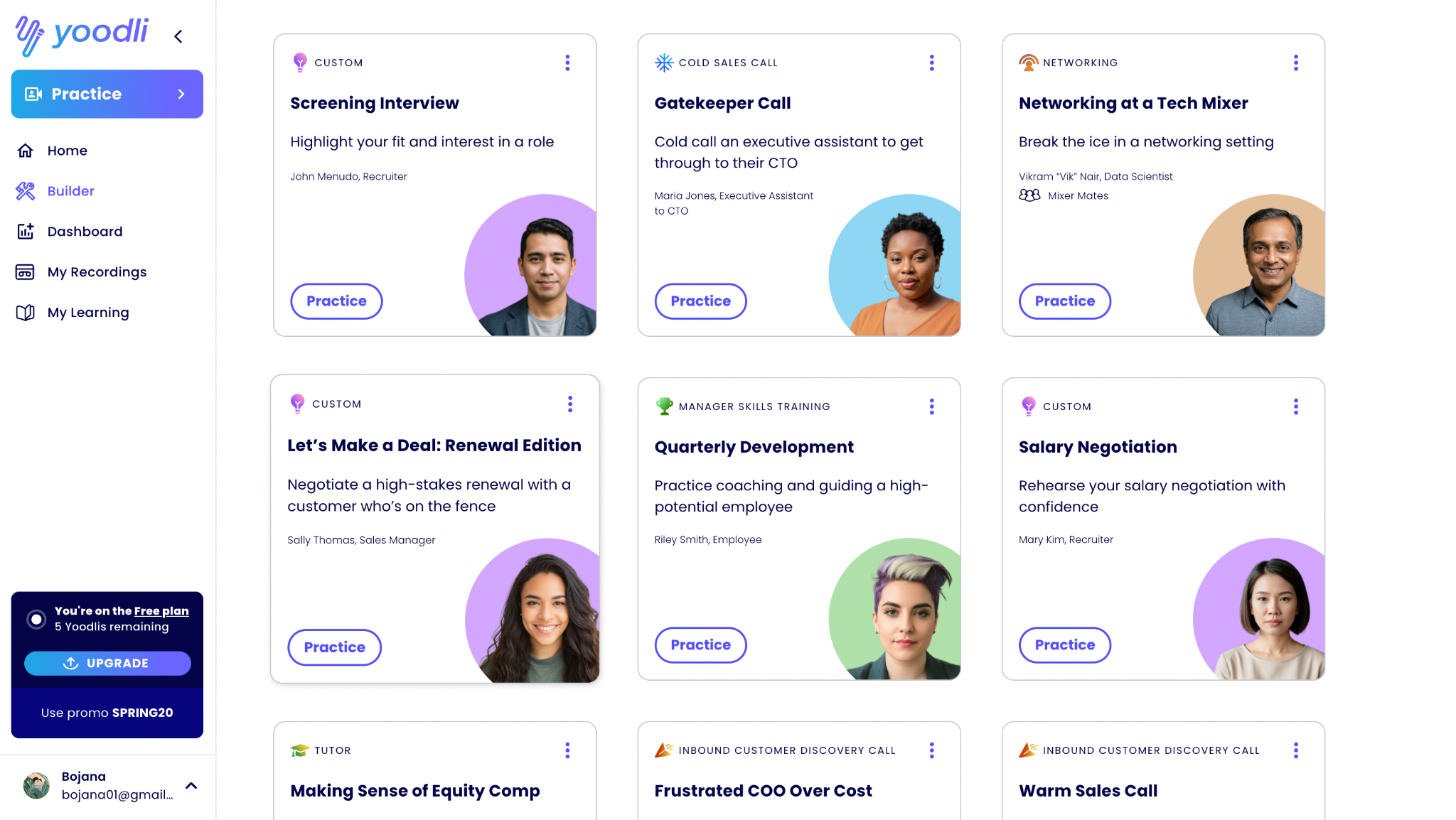
Users can practice responses to interview questions in a private environment while getting instant feedback on filler words, pacing, speaking speed, pauses, confidence signals, eye contact and body language, clarity, answer structure, and follow-up response handling.
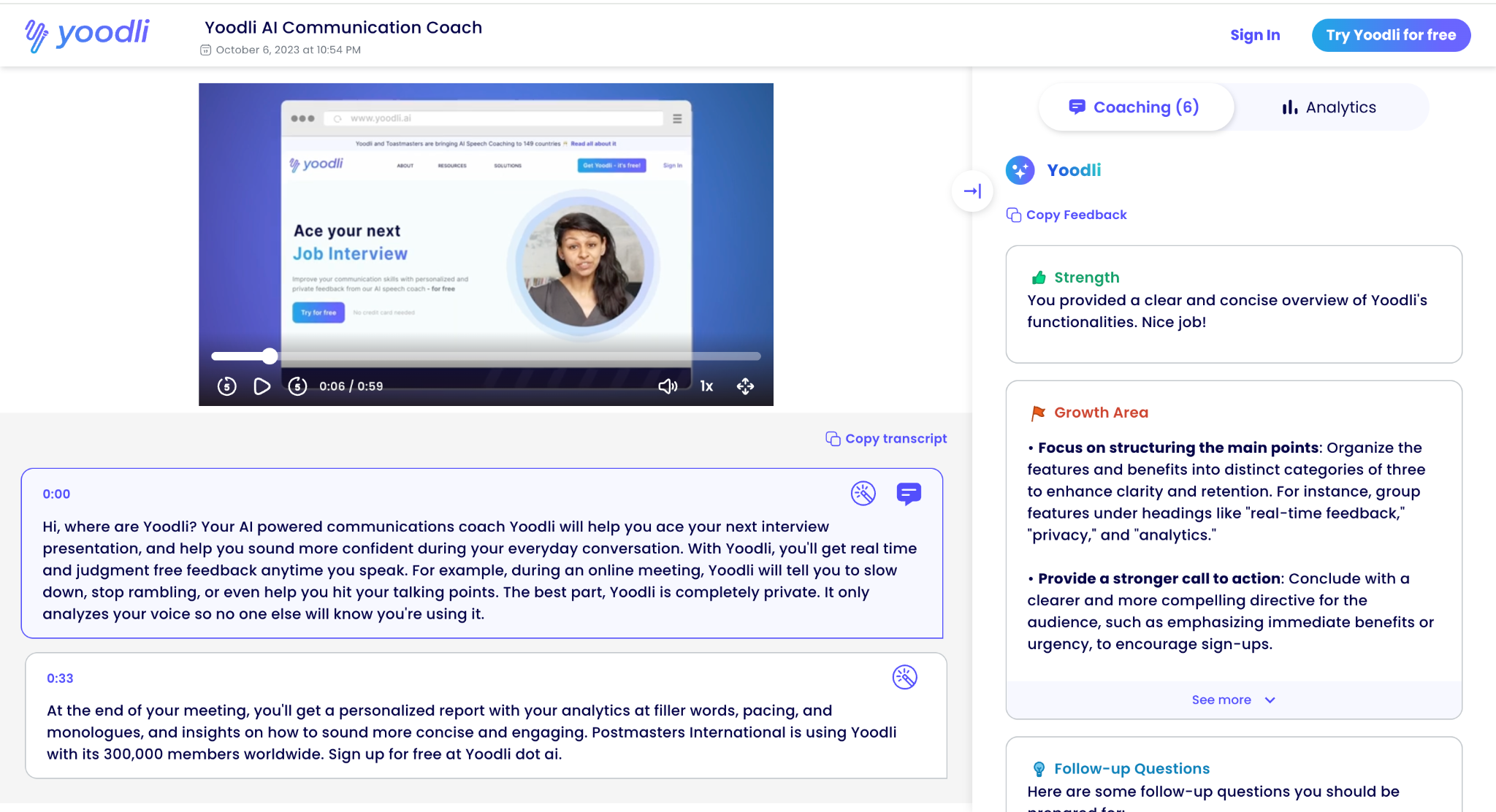
One of its strongest features is dynamic AI roleplay, where the system behaves like an interviewer and asks contextual follow-up questions based on what the learner says.
Where Yoodli Is Strongest: Delivery and Repetition
Let’s start with what Yoodli does exceptionally well.
Speaking feedback is immediate
This is probably Yoodli’s strongest differentiator. The platform quickly reveals speaking habits that learners often can’t self-diagnose:
- Speaking too fast
- Overusing “um,” “like,” “you know”, other filler words and verbal tics
- Long, rambling answers
- Poor pacing
- Inconsistent eye contact
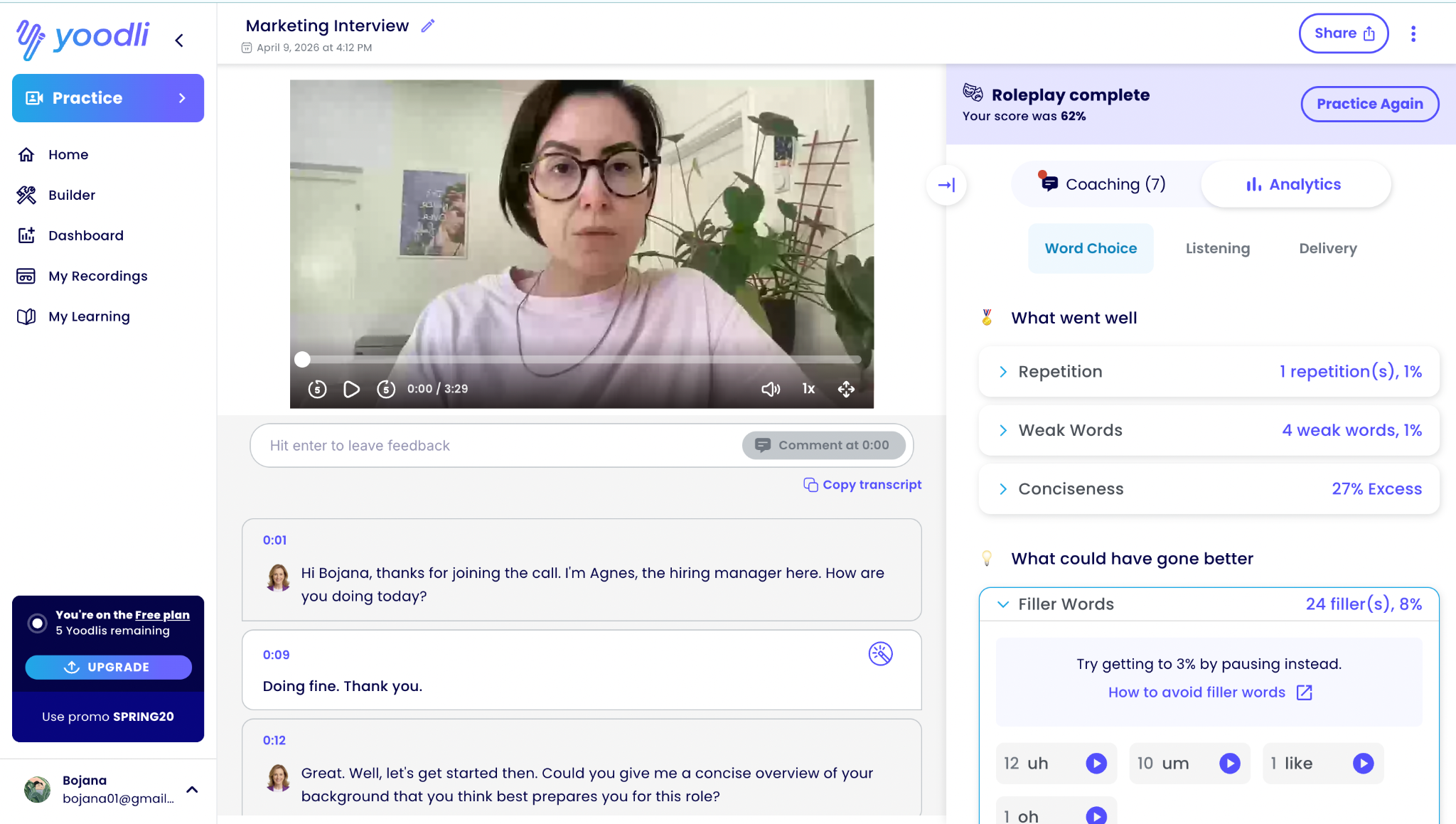
For many candidates, this kind of instant feedback instantly shortens the improvement cycle. Instead of waiting days for a coach to review a mock interview, learners can practice multiple times in a single sitting.
In interview preparation, progress often comes from frequency, not intensity: the more times candidates practice saying an answer out loud, the stronger their performance becomes, and Yoodli is excellent at enabling that repetition loop.
Private practice lowers performance anxiety
Many learners hate practicing in front of a coach, professor, or manager. They overthink or become too self-conscious. Yoodli’s AI-based, “judgment-free” environment reduces that friction and provides unbiased feedback.
That privacy-first positioning is one reason educators and trainers frequently use it to supplement live coaching. For organizations, this can help increase practice participation: people are simply more likely to practice when nobody’s watching them fail.
AI follow-up questions create better realism
Compared to older mock interview tools that rely on static question libraries, Yoodli’s AI roleplay is stronger. It introduces contextual follow-ups that better simulate real interviewer behavior.
Real interviews are conversational and the ability to handle unexpected follow-up questions beyond the rehearsed ones is often where candidates struggle most.
Where Organizations Need to Look More Critically
Yoodli is excellent as a free-form interview simulator, but organizations like workforce development programs, career centers or non-profits often look for more than simulation. They need curriculum structure and a tool that lets them build repeatable learning systems.
In practice, this means:
- Assignments
- Milestones
- Completion tracking
- Standardized rubrics
- Progression frameworks
- Curriculum integration
- Measurable readiness stages
- Integration with existing systems
Instead of just “practice whenever you want,” organizations often need to create a curriculum that may stretch over a few weeks.
For example, they may want to cover some interview fundamentals in the first week, behavioral interviews in the second, then focus on employer-specific questions in the third. Having this kind of an instructional workflow is often more important than the simulation engine itself.
This is particularly important for nonprofit workforce programs that serve hundreds or thousands of learners with limited coaching staff. For them, the real problem is operational scale, not just practice quality.
A workforce nonprofit serving 500 to 5,000 learners has one main operational problem: How do we prepare massive cohorts with a staff team of 10–20 coaches? Even if the AI coaching itself is excellent, organizations still need to be able to scale.
Programs need systems that help them assign interview practice, track completion, identify at-risk learners, standardize expectations, reduce live coaching load, and export evidence for funders.
In a day-to-day life of an instructor, this means knowing:
- Which students completed the assignment
- Who practiced 3+ times
- Who still scores below readiness thresholds
- Which cohort is behind
- What evidence/results can be exported for grant reporting
Reporting and Scalability
For organizations like nonprofits and career services teams, visibility matters. Leadership needs to know usage volume, practice frequency, readiness trends, completion by cohort, and participation rates.
Many buyers care less about the AI engine itself and more about whether the tool can support board reporting, donor reporting, grant renewals, or internal KPI reviews.
Yoodli performs well as a coaching tool, but for high-volume workforce programs, teams may need deeper assignment and cohort reporting workflows depending on the program design.
Privacy Concerns
Some online discussions and Yoodli community feedback have raised concerns around how user-generated recordings and practice content may be used under platform terms, particularly in AI-training contexts.
This doesn’t automatically make the platform problematic. But for organizations serving vulnerable populations or federally funded programs, data privacy review should be part of procurement.
Questions you should ask:
- How is recorded data stored?
- Is content used for model training?
- What retention controls exist?
- Are recordings exportable or deletable?
- Is there FERPA / education privacy alignment?
- Are enterprise privacy terms different from free-tier terms?
Yoodli Alternative for Organizations that Want to Scale Interviews
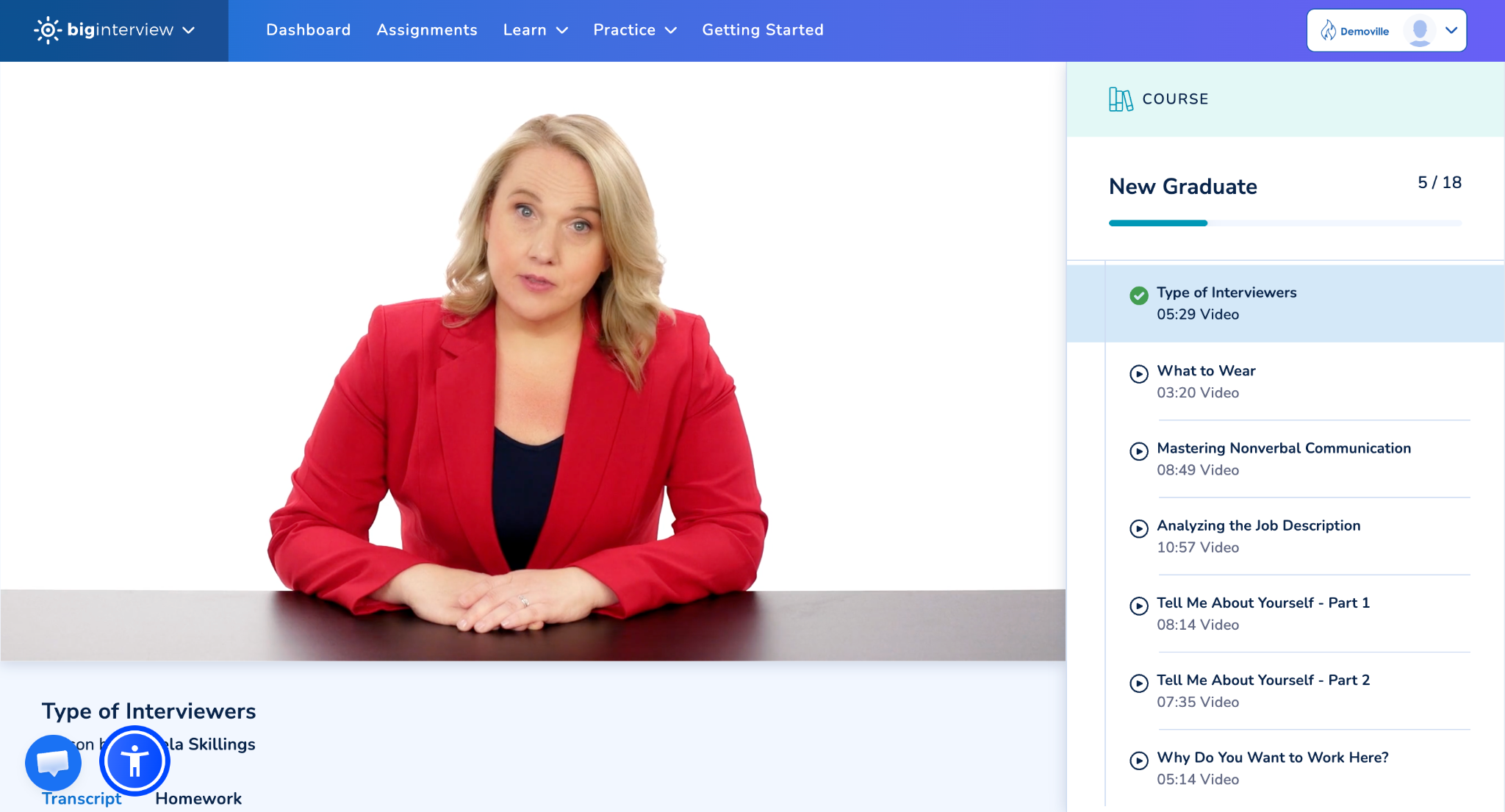
Big Interview is a Yoodli alternative that’s not only built for individual practice, but also for organizations that are running interview preparation across large cohorts with very limited staff.
Your team assigns tasks and deadlines, then participants complete the assigned work on their own time. You can track completion rates and review progress with custom assignments, usage dashboards, and built-in LMS integration (Canvas, Salesforce PMM, Apricot, and CaseWorthy are all supported).
On the learner side, every participant gets more than an interview simulator. Big Interview comes with structured lesson content within the app and its AI is purpose-built for interview preparation. This means participants get clear, real-life, actionable feedback and can correct most errors on their own. By the time they reach a 1:1 session, the basics are already in place, so your staff can focus on deeper, personalized support rather than basic corrections.
Summary of the Main Points
- Yoodli works for organizations if your primary need is self-practice and delivery refinement.
- It works well for corporate L&D teams, especially in sales enablement, tough workplace conversations, leadership communication, promotion prep, or manager coaching.
- For career centers and nonprofit workforce programs, Yoodli can be used as a self-practice layer before live coaching. Learners arrive at live sessions having already covered the basics like the STAR method, “Tell me about yourself”, or the strengths–weaknesses question.
- If your organization needs a structured curriculum, assignment workflows, cohort tracking, funder-ready reporting, and standardized rubrics, education-first platforms with structured lesson content often have the edge.