Internship interviews can feel scary, especially if it’s your first real interview experience.
Let me calm your nerves a bit: interviewers know this is stressful and they don’t expect you to be perfect. They will look for potential — things like curiosity, communication skills, your ability to learn quickly, and signs you’ll be reliable to work with.
Below, I break down 10 common internship interview questions, what employers are really asking, and how to answer each one confidently.
Before I get into the questions, here are a few things to keep in mind:
- Research the company beforehand so you can speak specifically about why you’re interested.
- Practice answering questions out loud. It helps more than silently rehearsing in your head.
- Use examples from classes, group projects, clubs, volunteer work, or part-time jobs.
1. Tell me about yourself
What they’re really asking:
This is a question that kicks off 99% of interviews, and a common mistake is to tell them your entire life story. The interviewers ask this to see if you can communicate clearly and give them a quick sense of who you are professionally.
How to answer:
Keep your answer concise and focused on:
- Your major or area of study
- Relevant coursework, projects, or activities
- What interests you about the field
- What you hope to gain from the internship
A strong answer might sound like:
“I’m currently studying marketing at NYU, and over the past year I’ve become really interested in social media strategy and brand storytelling. I recently worked on a group project where we created a campaign for a local business, and I realized how much I enjoy combining creativity with analytics. I’m now looking for an internship where I can continue developing those skills in a real-world environment.”
2. Why are you interested in this internship or company?
What they’re really asking:
“Did you actually research us, or are you applying everywhere?” Interviewers want to see genuine interest and effort.
How to answer:
Avoid generic answers like “I just want experience.” Instead, explain why this specific opportunity stands out to you. Mention something specific about the company’s mission or products, why the industry interests you, and how this internship fits your career goals.
For example:
“I’m excited about this internship because your company focuses heavily on sustainability, which is something I’ve been studying in several of my courses. I also like that interns get exposure to multiple teams instead of only one area.”
3. What do you hope to gain from this internship?
What they’re really asking:
“Are you motivated to learn and grow?” Interviewers know interns are still early in their careers, so they don’t expect you to already have everything figured out. They want to understand if you’re genuinely interested in getting new skills, learning from experienced professionals, and taking initiative instead of passively waiting to be told what to do.
How to answer:
Mention 1–3 specific skills or experiences you want to develop, such as:
- Communication
- Technical skills
- Project management
- Collaboration
- Industry knowledge
You can also mention mentorship or learning how professional environments work.
For example:
“I’d love to strengthen my data analysis skills, but I also want to learn how teams collaborate in a professional setting and how projects move from idea to execution.”
4. What are your biggest strengths and weaknesses?
What they’re really asking:
“Are you self-aware?” They want to check if you can honestly evaluate yourself. They’re also paying attention to how you talk about things you need to improve and what you’re doing about it.
How to answer
For strengths, choose qualities that are relevant to the role and back them up with examples.
For weaknesses, pick something real but manageable and explain how you’re actively improving it. Avoid cliché answers like: “I’m a perfectionist.”
A better approach:
“I used to struggle with speaking up in group settings because I worried about saying the wrong thing. Over time, I’ve been pushing myself to contribute earlier in discussions and participate more actively during presentations.”
5. Why are you a strong candidate for this internship?
What they’re really asking:
“What makes you worth investing in?” They want to see if you’re curious, reliable, adaptable, can learn quickly and contribute positively to the team. They also want to confirm that you’re coachable, open to feedback and can handle smaller, less glamorous tasks without complaining.
How to answer:
Focus on skills you already built and can use in this role, willingness to learn, work ethic, enthusiasm, and initiative. Even if you don’t have any professional experience, you can still talk about:
- Coursework
- Leading school projects
- Campus activities
- Part-time jobs
- Personal projects
For example:
“I’m still early in my career, but I’m someone who learns quickly and genuinely enjoys solving problems. I’ve also balanced classes with a part-time job, which has helped me become organized and dependable.”
6. Where do you see yourself in 5 years?
What they’re really asking:
“Do you have direction and motivation?” Nobody expects you to really know exactly. But they do want to see how you see your future, how your goals generally align with the internship, and if you seem motivated to keep learning and progressing over time.
How to answer:
Focus on the field or type of work you’re interested in, skills you hope to build, and areas you’d like to grow into. Direction matters more than having an exact job title mapped out.
For example:
“In five years, I’d like to be working in digital marketing, ideally in a role where I can combine strategy and creative work. Right now, I’m focused on building foundational experience and figuring out which areas I’m most passionate about.”
7. Describe a challenge you faced and how you handled it.
What they’re really asking:
“How do you respond to difficulties?” They’re trying to understand how you behave when things don’t go smoothly. Do you panic? Avoid responsibility? Or step up and try to solve the problem. They also want to see if you can stay calm under pressure, think practically, and learn from situations instead of repeating the same mistakes.
How to answer:
Use the STAR method, a simple structure that helps you turn experiences into clear, confident stories.
- Situation: Set the context. What was happening? (e.g. a group project, deadline, team issue)
- Task: What was your responsibility or goal in that situation?
- Action: What did you do to handle the challenge (this is the most important part).
- Result: What changed because of your actions? If possible, include an outcome or what you learned.
This format helps you stay focused instead of rambling, and it shows interviewers that you can think clearly about problems and your own role in solving them.
For example:
“During a group project, one team member dropped out shortly before the deadline. I helped reorganize responsibilities, communicated with the professor, and worked with the remaining team members to finish the project on time.”
8. Tell me about a time you had a disagreement with a teammate.
What they’re really asking:
“Can you work well with others?” They’re looking for maturity and proof you can handle conflicts without creating drama.
How to answer:
Focus on listening, professionalism, communication, and compromise. Avoid blaming the other person or making yourself sound impossible to work with.
A strong answer might include:
- calmly discussing different perspectives
- finding common ground
- prioritizing the project goal over ego
“During a group project in university, two of us had different ideas about how to structure the final presentation — I wanted to keep it very data-heavy, while my teammate felt it should be more visual and story-driven. Instead of pushing my approach, I suggested we step back and look at the assignment criteria together. After discussing it, we realized we could combine both approaches: use visuals to tell the story, but keep the data in backup slides for depth. We split the work based on our strengths, and the final presentation ended up being well-received by the professor. It also made the collaboration smoother because we were both heard and the focus stayed on the project outcome rather than our individual preferences.”
9. How do you stay organized when juggling multiple deadlines?
What they’re really asking:
“Can we trust you to manage responsibilities?”
How to answer:
Talk about actual systems you use: calendars, to-do lists, Notion or Trello, scheduling apps, and prioritization strategies.
For example:
“I usually break large assignments into smaller tasks and plan them out in my calendar throughout the week. That helps me avoid leaving everything until the last minute.”
10. Tell Me About a Time You Failed or Made a Mistake
What they’re really asking: “Can you take accountability and learn from your mistakes?” Everybody makes mistakes. Interviewers want to see how you respond afterward.
How to answer:
Choose a real example where you:
- Recognized the mistake
- Took responsibility
- Learned something valuable
- Improved afterward
For example:
“I once underestimated how long a project would take and ended up rushing near the deadline. Since then, I’ve become much more proactive about planning ahead and building extra buffer time into my schedule.”
Bonus: Questions You Should Ask the Interviewer
At the end of the interview, you’ll usually get the chance to ask questions. Don’t skip this part. Thoughtful questions show interest and preparation.
Here are a few strong options:
- What does a typical day look like for an intern here?
- What qualities make interns successful on your team?
- What kinds of projects do interns usually work on?
- What do interns usually learn by the end of the internship?
You’ve read through the questions, and that’s a great first step. Reading interview advice helps, but practicing your answers out loud is what actually builds confidence and makes a real difference.
If you want to prepare in a more realistic way, Big Interview’s AI Interview Simulator lets you practice common internship interview questions.
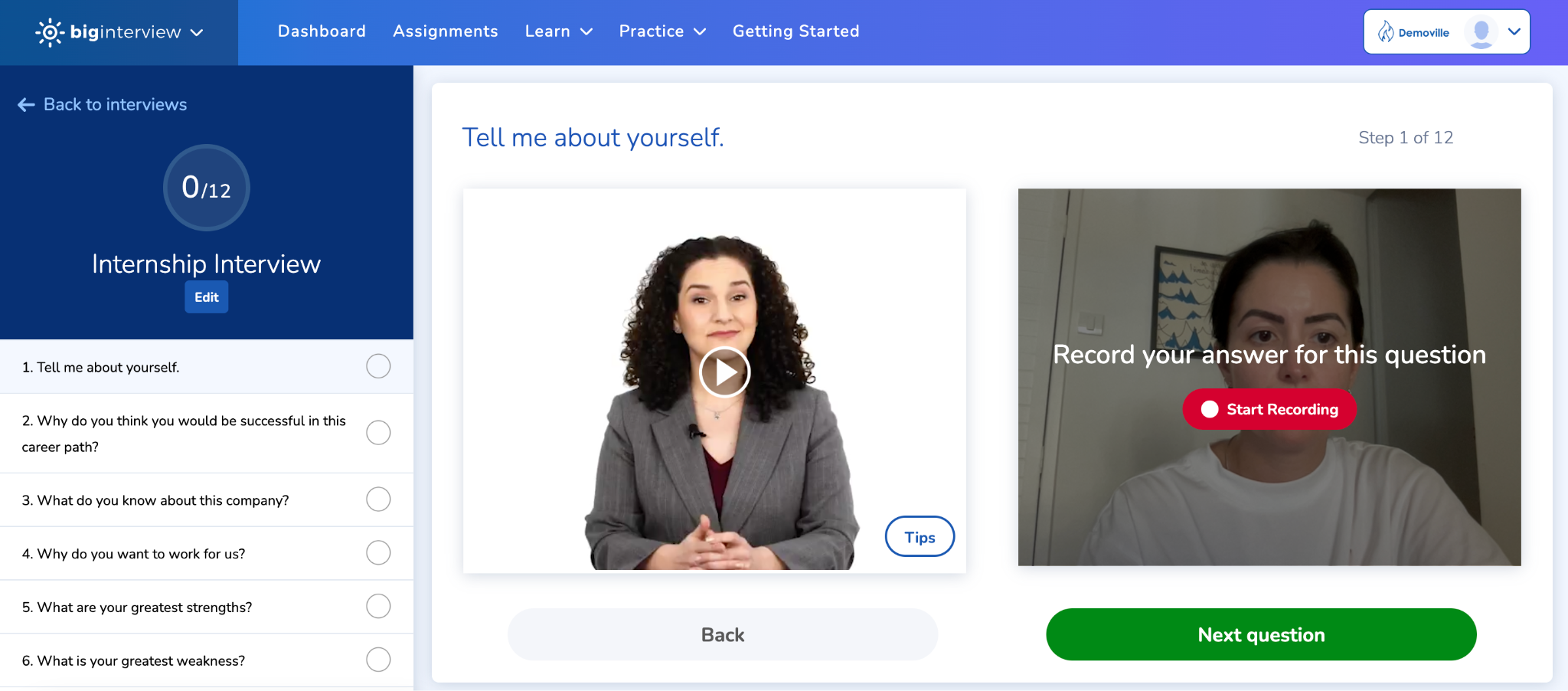
This is how it works:
- You record yourself answering interview questions on video
- You submit your recording to AI
- You get immediate feedback on what to improve
Log in to start practicing.