You’ve got 60 people in a cohort. One coordinator. And a placement rate you’ll need to justify in your next board meeting.
On paper, it’s a program. In reality, it’s often chaos.
Some participants don’t know what jobs they’re aiming for yet. Others submit resumes that need multiple rounds of edits. Mock interviews start strong… and then confidence drops the second it’s time to apply for real roles. A few quietly disappear somewhere between “I’ll start applying next week” and actually doing it.
And all of that lands on one coach.
This isn’t new, it’s just getting harder.
Workforce nonprofits are expected to deliver highly personalized career support at a scale that doesn’t match their staffing. One coach might be responsible for 50, 80, sometimes 100 active job seekers.
Which means:
- You’re not reviewing every resume.
- You’re not running enough mock interviews.
- You’re definitely not catching every person who’s starting to disengage.
At some point, it stops being a coaching problem and becomes a capacity problem.
That’s where AI tools can help — if you use them intentionally.
Because most “top AI tools” lists won’t get you there. They’ll throw features at you without answering the real question: how does this actually fit into your day-to-day program?
This piece takes a different approach. Instead of tools first, we’ll look at the workflow of a well-run career coaching program, and where AI can realistically step in to support each stage.
The Career Readiness Journey Your Program Needs to Support
Think of cohort members moving through five stages before they’re genuinely job-ready:
- Career clarity: knowing what they’re actually going after
- Document readiness: a resume and LinkedIn profile that won’t get screened out
- Interview confidence: being able to talk about themselves without freezing
- Communication delivery: tone, pacing, presence, especially for ESL speakers or career returners
- Job search execution: actually applying, following up, and not disappearing
Programs lag on career clarity, where studies link poor goal-setting upfront to lower satisfaction and fit, and on execution/retention, as low long-term job retention and follow-up support are common critiques despite decent initial placements.
Duja evaluations highlight job retention as a “vital measure” often weak post-training, backing stage 5 gaps.
Let’s go through each stage.
Stage 1: Helping Cohort Members Figure Out Where They’re Headed
Tool: CareerVillage Coach
Before anything else can work — the resume, the interview prep, the job search — a cohort member needs to know what they’re aiming at. When they don’t, it stalls everything downstream.
Coaches end up spending 1:1 time on exploratory conversations that eat into the hours they should be spending on people who are actually ready to apply.
CareerVillage Coach is an AI-powered career development platform built specifically for workforce programs and educational institutions.
It’s not a generic chatbot — it runs structured career development activities through a chat interface, covering career exploration, pathway planning, and job search readiness.
It was co-designed with more than 20 career development organizations and workforce boards, and as of early 2026, it supports around 125,000 users across higher education, workforce, and nonprofit partners.
The practical value for coordinators: cohort members who go through structured exploration activities before meeting with a coach arrive with more focus. They’ve already worked through “what do I want to do” and “what are realistic options given my background” — which means your staff can skip the basics and get into more useful territory.
CareerVillage Coach is also SOC 2, FERPA, and GDPR compliant, which matters for programs handling sensitive learner data. It supports multiple languages, making it a solid fit for programs with diverse or international cohorts.
Who needs this most: Programs where cohort members arrive at very different career stages, or where staff time is getting eaten by early-stage exploratory conversations.
Stage 2: Getting Resumes and LinkedIn Profiles Employer-Ready
Tools: Big Interview (primary) + Resume Worded (complementary)
This is where programs most visibly break down at scale. One coordinator cannot personally review 80 resumes with meaningful, specific feedback.
What actually happens: a few people get detailed notes, most get a glance and a “looks good,” and everyone submits documents of wildly uneven quality.
Resume Worded handles the LinkedIn side of this well. It scores profiles, flags weak headlines, and gives line-by-line recommendations on how to make a profile more visible to recruiters.
For cohort members who haven’t updated their LinkedIn in years — or who built one for the first time during your program — it’s a low-friction way to get to a much better baseline without coordinator involvement.
For resume scoring and feedback, Big Interview is the stronger tool.
Beyond its interview prep capabilities (more on that in the next section), Big Interview’s resume features give cohort members structured, immediate feedback on their documents — the kind that used to require a coach sitting down with each person individually. Coordinators can assign resume work as part of the curriculum, track who’s completed it, and see who still needs attention before they get anywhere near a live interview.
The key difference: Resume Worded is strong for LinkedIn optimization and works well as a self-serve tool. Big Interview sits inside a program structure with assignments, tracking, and admin visibility — which is what you actually need when you’re managing a cohort, not just individual job seekers.
👉 For a deeper look at how Big Interview handles resume prep, check out our full resume guide.
Who needs both: Programs where cohort members are expected to have an active LinkedIn presence as part of their job search. If LinkedIn isn’t part of your program’s job search strategy, Big Interview alone covers resume prep.
Stage 3: Building Interview Confidence Through Structured Practice
Tool: Big Interview
This is where Big Interview is built to live.
The platform offers a 170-lesson curriculum covering everything from behavioral questions to industry-specific prep to job-level tracks (entry-level, management, executive). Coordinators can assign specific tracks to cohort members rather than handing them a platform and hoping they find what’s relevant — which is what actually leads to consistent use.
For coordinators, the admin dashboard is the real operational unlock.
You can see exactly who has practiced, how many sessions they’ve completed, how their AI scores are trending, and who hasn’t touched the platform in two weeks. That last group — the ones who’ve gone quiet — is who needs a nudge. Instead of asking everyone in your next session “how’s the interview prep going?”, you already know who to check in with individually.
The AI feedback is trained by industry coaches and evaluates answers on content, structure, and delivery.
Cohort members get feedback immediately after each answer — no waiting days for a human to grade a video recording. For a job seeker who’s anxious about interviews, practicing at 11pm and getting instant feedback on whether their answer was clear and on-point is meaningfully different from submitting a video and waiting.
A few areas worth calling out for specific populations:
- ESL speakers: Big Interview includes curriculum tracks designed for non-native English speakers, covering common language pitfalls in interview settings and how to present confidently without losing your voice.
- Career changers: There are tracks specifically for people pivoting industries or re-entering the workforce after a gap — two populations that show up frequently in nonprofit programs.
- First-gen job seekers: The curriculum walks through professional norms that experienced job seekers take for granted but that genuinely need to be taught explicitly.
The reporting features feed directly into smarter coaching conversations. When a cohort member sits down with their coach, both parties can look at AI scores and specific answer recordings. The coach’s time goes toward interpreting patterns and coaching on nuance — not on administering a mock interview from scratch.
From the field: one program coordinator summed it up this way: “When they arrived, the resumes were mostly ready.” That’s what structured, tracked AI prep looks like in practice — cohort members arriving at the human coaching stage already at a higher baseline.
👉 Deep dive on Big Interview’s interview prep features: full guide coming soon.
Who needs this: Every program running interview prep at any meaningful scale.
Stage 4: Turning Nervous Talkers Into Confident Communicators
Tools: Big Interview + Yoodli
There’s a difference between knowing how to answer an interview question and actually sounding confident when you do it.
Delivery — pacing, filler words, eye contact, tone — is its own skill, and it’s one that trips up a lot of job seekers who’ve done all the right preparation.
Big Interview handles the interview-specific delivery layer: AI feedback on recorded answers covers tone, word choice, structure, and delivery in the context of actual interview questions. Cohort members can watch their own recordings, see their AI scores, and practice the same question repeatedly until they feel the difference.
Yoodli takes a different angle. It’s an AI communication coaching tool that gives feedback on how someone speaks in any professional context — not just interviews. It analyzes pacing, filler words like “um” and “uh,” and overall speech clarity. The feedback is immediate and judgment-free, which matters for people who are already self-conscious about how they come across.
Where they complement rather than duplicate each other:
- Big Interview is better for interview-specific prep — the full picture of content + delivery in an actual Q&A format.
- Yoodli is better for cohort members who have a deeper communication confidence gap that shows up outside interviews too — in networking conversations, presentations, or workplace meetings. ESL speakers, first-gen professionals, and career returners often fall into this bucket.
That said, Big Interview’s curriculum for ESL speakers and career changers covers significant ground in this area, so for many programs, Big Interview alone is sufficient. Yoodli becomes relevant when you have cohort members whose communication anxiety goes beyond interview prep.
Who needs Yoodli in addition to Big Interview: Programs with a high proportion of ESL speakers or cohort members who need communication coaching that extends beyond the interview room.
Stage 5: Keeping the Job Search Organized and Moving
Tool: Prentus
Here’s a familiar situation: a cohort member finishes your program well-prepared, confident, resume polished. Then they disappear. They’re applying, sort of. Following up, maybe. But there’s no structure to it, and without structure, most job searches stall out within a few weeks.
Prentus is a job search management platform built for programs like yours.
Cohort members use it to track applications (pulled automatically from LinkedIn, Indeed, ZipRecruiter, and others), log follow-ups, and work through weekly career plans. For coordinators, there’s a program-side view that shows where each cohort member is in their search — without requiring them to self-report.
The platform includes an AI career advisor, a resume builder, a cover letter generator, and a LinkedIn optimizer alongside the job tracker. It’s designed for recent grads and career-changers coming out of bootcamps and workforce programs — not seasoned professionals — which means the experience is calibrated for people who are figuring out the process for the first time.
The coordinator value: you can see who’s actively applying and who’s stalled, without scheduling a check-in with everyone. That’s the difference between proactive support and waiting for someone to reach out when they’re already demoralized.
Who needs this most: Programs where job search accountability is a known drop-off point, and where staff don’t have capacity to manually track cohort members’ search activity.
You Don’t Need Five Tools: Here’s How to Simplify
Tool fatigue is a real problem. Add too many platforms to your program and cohort members use none of them consistently. Every new login is a friction point. Every new interface is a reason to disengage.
Here’s the practical simplification:
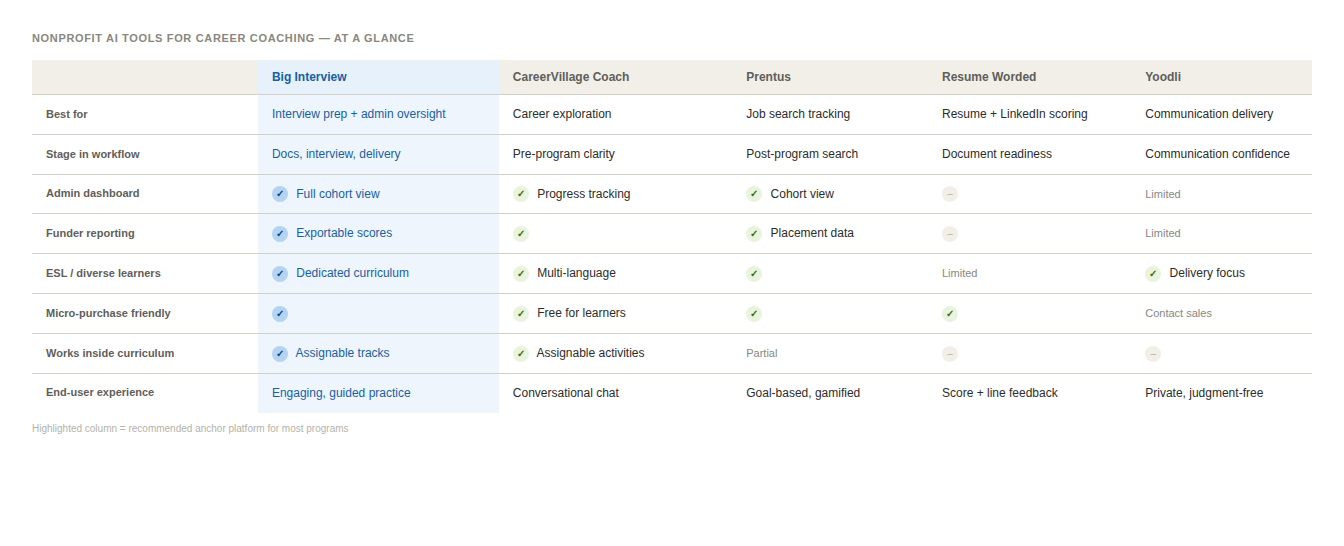
Big Interview is your anchor platform. It covers resume prep, interview content, delivery feedback, curriculum structure, admin tracking, and reporting — in one place, with one login for cohort members. For program coordinators, the admin dashboard means you’re managing one system, not five.
For funders and boards: Big Interview’s reporting gives you exportable evidence of practice volume, skill scores, and engagement — exactly what you need to demonstrate service delivery at grant renewal time. It fits within the federal micro-purchase threshold (under $50,000 annually), which means many federally funded programs can skip the full RFP process and procure it directly. It’s also WCAG 2.1 AA compliant, which checks the accessibility box that the DOJ’s 2024 rule created for public-facing platforms.
The gaps Big Interview doesn’t fill:
- Pre-interview career clarity: Add CareerVillage Coach if cohort members are arriving without a clear direction. It handles the exploratory work before the job-readiness stage starts.
- Job search execution and accountability: Add Prentus if post-program drop-off is your biggest problem. It gives structure to the search itself and visibility to coordinators.
- LinkedIn-specific optimization: Resume Worded fills this gap if your program requires a polished LinkedIn presence. For many workforce programs, it’s optional.
- Communication coaching beyond interviews: Yoodli is worth considering for programs with significant ESL populations or cohort members with deeper communication confidence gaps. But be honest about whether this is a real gap or a nice-to-have — Big Interview’s ESL and career-changer curricula cover a lot of this ground already.
The minimum viable stack for most programs:
Big Interview + one supporting tool based on your cohort’s biggest gap.
If cohort members need direction before they start: Big Interview + CareerVillage Coach. If post-program job search accountability is your bottleneck: Big Interview + Prentus.